December 2022
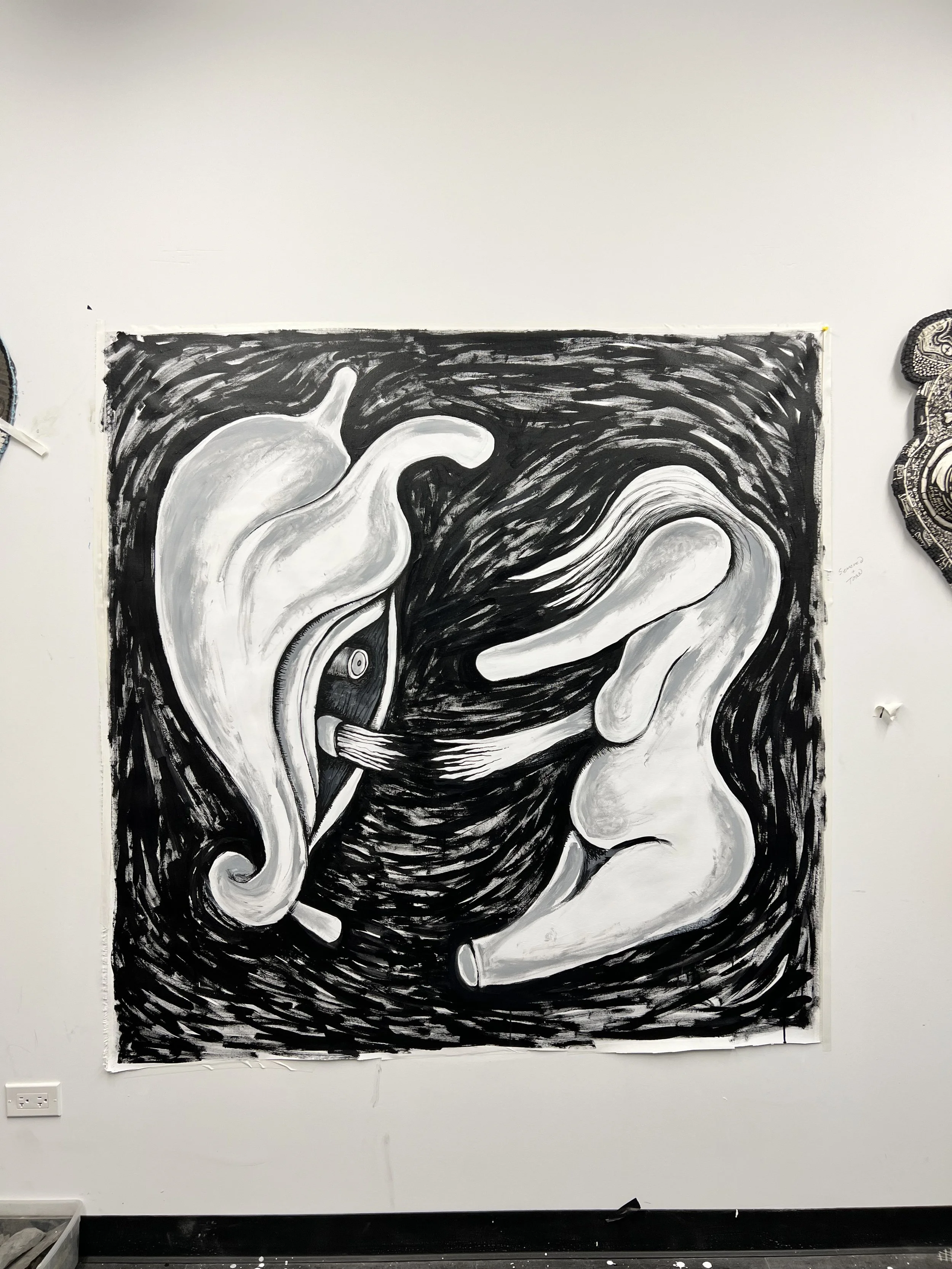
Severed and Torn. How does one remember something unseen and unknown? It was her, my source, my heart. The sinews of a thousand mothers dangling and reaching out to me. I know this wholeness in the empty spaces and missing parts- they yearn and ache for the re-tethering.
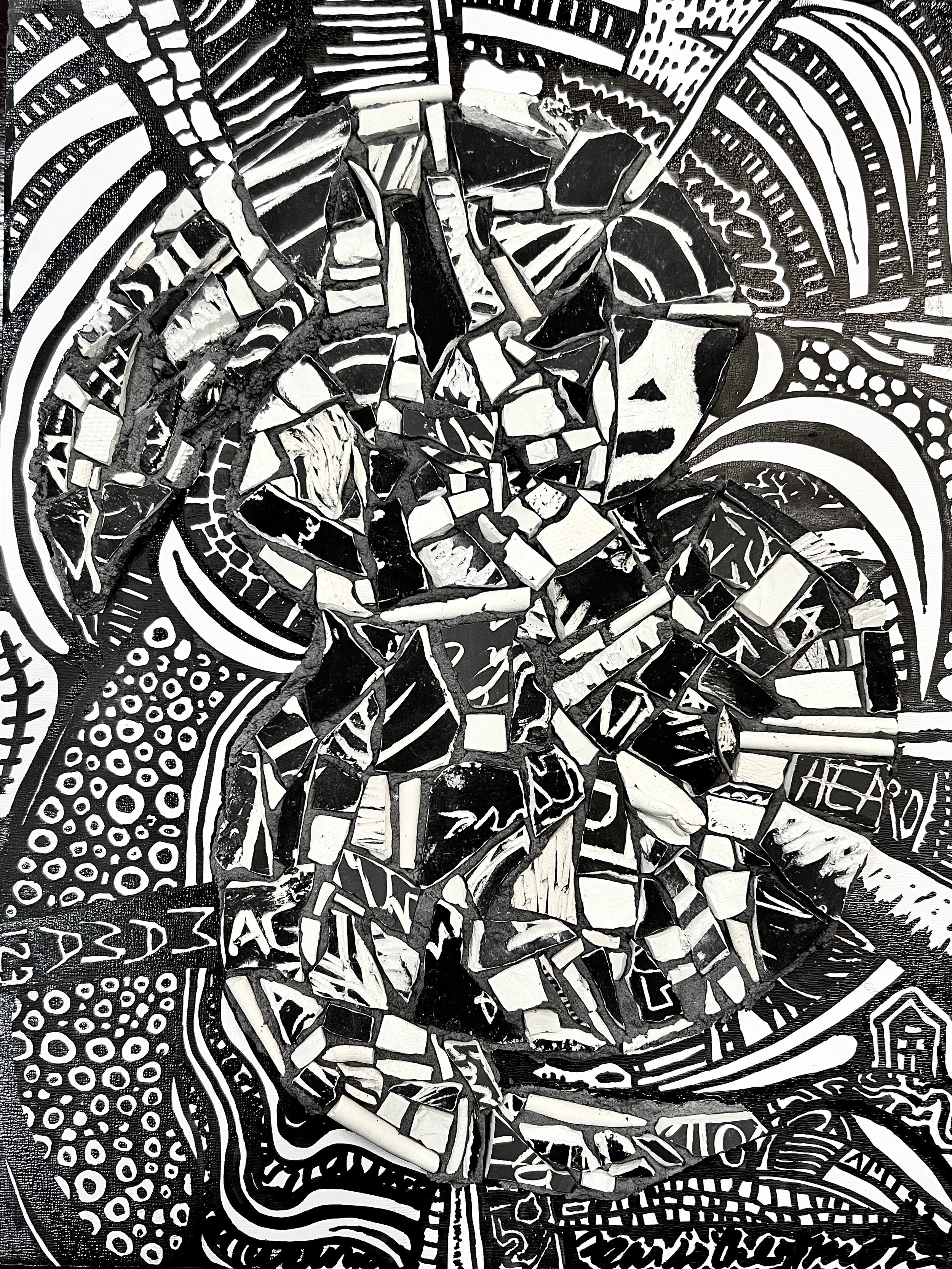
Juxting mosaic/drawing experiment#3
In todays’ lexicon, the word mosaic means a bringing together of diverse, unrelated, individual peoples, communities, elements or ideas, in one place or realm, and envisioning this “togetherness” as new structure. This definition of mosaic is an ideology that imagines the collective, not the Individual elements which may have less visibility or power on their own. If one is a lone individual, they may not be seen or heard; perhaps they are marginalized because of societal bias or discrimination they don't have the power to be seen on their own. How is this union, a metaphor for repair and acknowledgement? Through my research and art practice I will evaluate and theorize how the act of creating and repurposing the ‘new’ from the broken and discarded, belongs to disciplines of art making that embody philosophies of fixing and repair.
My practice is both post and multidisciplinary and I use a synthesis of material knowledge to negate traditional characterizations of the mosaic art form. My hybrid approach is connected to sculpture, drawing, assemblage, ceramics, collage, bricolage through deconstruction and rebuilding, reinvention and reconfiguration -this process is a response to fix the damage in ourselves and in the world. This way of working follows ideologies of traditional Japanese aesthetic philosophies of both Wabi-sabi and Kintsugi, derived from and connected to the Three Marks of Existence in Buddhist teachings- (impermanence, suffering, not-self). These ideologies can also be connected to contemporary art practices that use problem solving to address subjects such as climate change, inequality, and posttraumatic memory.
This metaphor is also part of my art practice. Throughout my career, I have struggled to make sense of my own fragmentation in an attempt to decode my life through my studio approaches and art. It was only when I began to take pieces and shards, and fragments or specifically deconstructed/cut/broken tesserae and made order and sense out of them- only then did I understand I was putting myself together in the process. An acceptance of the value in the broken, the discarded, the obsolete, the destroyed is to know it as part of nature, of the “ mutability and ephemerality of life” The threats of destruction from outside sources (weather, war, plagues) and from within (mental illness, anxiety, grief, separation) permeate our existence, yet our ability to transform and adapt embraces possibility by picking up the pieces can reshape our world and ourselves.
As a practitioner and community arts organizer, I have witnessed a resurgence of interest in mosaic as a public art form and individual studio practice. In the last two decades in particular, there is a renewed enthusiasm for this art form as well as a demand for structural education in this medium. Over the last decade, these institutions and independent art studios have influenced and encouraged hundreds of artists to follow ancient traditions and a developing contemporary methodology. Additionally, there has been recent research in the field; two examples are by A. Pantic, “Creative Practice of Mosaic Art, The Heritage Within” (2018), and M. DeMelo,“Mosaic as an Experimental System”, (2019) to name a few.
Yet within the context of modern art, the tightrope between the ever-present modern art versus craft debate, mosaic art, like ceramics and fiber art, casts its functional and process driven shadow upon much contemporary mosaic artwork. “Craft is the skillful manipulation of technique and art is the skillful manipulation of ideas” and the intersection of the two has been coined, ‘sloppy craft’. This approach to the masterful manipulation and understanding of materials and techniques combined with “de-skilling” . In his essay, “ An impression of deja vu; Craft, the visual arts, and the need to get sloppy”, Denis Longchamp defines the crossover from perfectionism ( craft ) to the deconstruction of perfection (visual art) “ Deskilling occurs when makers distance themselves from a technical to Mastery of their craft medium and engage in any form of re-skilling by which the express the critical content of their work.”skill, perfectionism and How can the outcome of the process dispel the underlying and unspoken and implicit assumptions, ideas and frameworks of “craft-oriented” mediums?
As a practitioner, this is what fascinates me; the weight of the process (hunting, gathering, organizing, composing, adapting, mending), and the objects that are created within the contexts of contemporary art. Visually, my narratives depart from classical ‘mosaic’ because I intuitively live and create with the belief we are born broken (imperfect) and we live and survive by mending. This approach to life and art are one and the same as outlined in my art practice. I was born to a survivor and became a survivor myself- incorporating scratches and cuts, drawing fragments and inscriptions as part of an additive and investigative method of mosaic. My compositions give a tactile and visceral understanding to stories of regeneration and renewal. There is power in this reclamation and my work embodies this concept.